
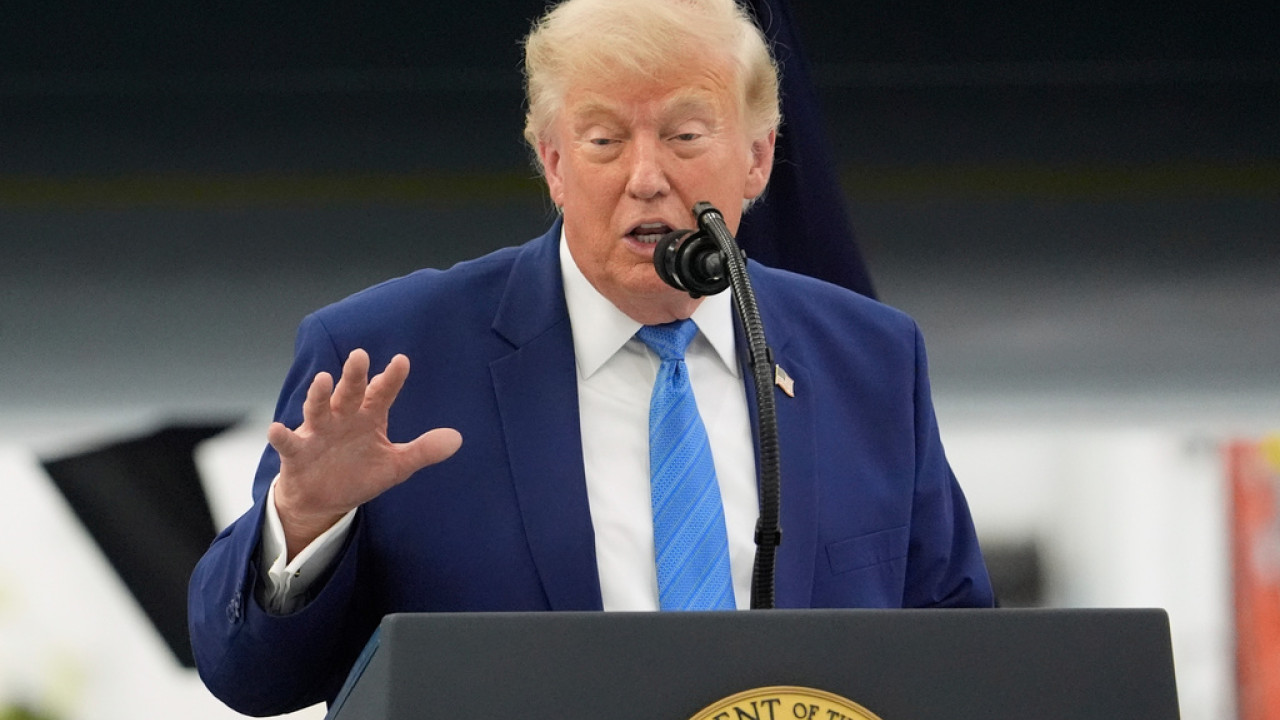

“These tariffs will supersede any trade agreement with that country, whether it’s already in place, signed, or pending,” he wrote.
Donald Trump has warned that the United States will immediately impose 100% tariffs on all imports from countries that move to impose a digital tax on US companies, making clear that the measure will override any existing or future trade deals.
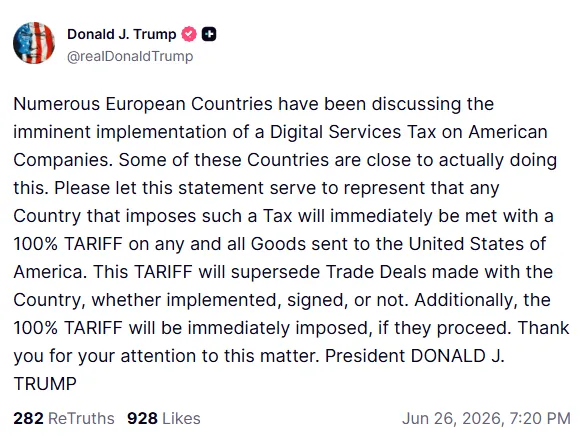
Trump wrote on Truth Social: “Several European countries are discussing the immediate implementation of a Digital Services Tax on US companies. Some of them are very close to adopting it.
Let this statement be a clear warning that any country that imposes such a tax will immediately face 100% tariffs on all products it exports to the United States.
These tariffs will take precedence over any trade agreement with that country, whether it is already in place, signed or pending.
In addition, 100% tariffs will be imposed immediately if these countries proceed with the implementation of the tax.”
Donald Trump has repeatedly opposed efforts by foreign governments to tax or impose tighter regulation on US tech giants. Last year it threatened to impose new tariffs on any country that took such measures.
In a post last August, he argued that digital taxes and regulations “are designed to harm or discriminate against American technology.”
Donald Trump’s fresh threat comes ahead of July 4, when the United States and the European Union are expected to start implementing the tariff deal, which provides for a top rate of 15 percent on the vast majority of European exports to the United States.
The European Union finalized a trade deal with the United States in May that limits most tariffs on European exports to 15 percent. The agreement came after months of negotiations within the EU, following an agreement in principle reached last year by European Commission President Ursula von der Leyen when she met Trump at his golf course in Scotland.
However, digital taxes were not included in the agreement and remain one of the main points of friction in relations between the United States and the European Union.
The US government has previously conducted investigations into digital taxes under Section 301 of the Trade Act of 1974. However, it remains unclear how Donald Trump intends to carry out his new threat and whether the tariffs will be imposed across the board or initially targeted at specific countries.
Britain, which is no longer a member of the European Union, will from 2020 apply a 2% digital tax on the revenue earned by search engines, social media and online platforms from users in the UK.
In a related document, the British government had argued that current digital business taxation rules create a mismatch between where profits are taxed and where economic value is generated.
The UK digital tax includes application limits so that it mainly burdens large multinational companies. According to the same document, the objective of the measure is to ensure that large multinationals covered by the scheme contribute fairly to the financing of essential public services.
Last week, just hours before they met on the sidelines of the G7 summit, French President Emmanuel Macron made it clear that France will not bow to pressure from Donald Trump and scrap the digital tax it imposes on US tech giants.
Before leaving for the summit in France, Trump had warned that the United States would have “no choice” but to impose 100% tariffs on French wine if Paris did not scrap the digital tax.
France applies from 2019 a tax of 3% on the revenues from digital services of companies with a turnover of more than 25 million euros in the French market and 750 million euros worldwide.
Source: Skai

